A practical breakdown of how today’s games generate revenue and what publishers and investors should look for when investing
Why Revenue Models Matter More Than Ever
The way games make money has changed dramatically over the past two decades. What was once a straightforward “sell a box once” business has evolved into a portfolio of long-term monetization strategies designed to sustain development, fund live operations, and extend player engagement.
For publishers and investors, understanding game revenue models is no longer optional. The chosen model affects player acquisition, lifetime value, risk exposure, operational costs, and ultimately, the scalability of a title or studio.
This article breaks down the most common game revenue models in plain language, explains how they work in practice, and highlights what they signal from a business perspective
A Publisher’s Lens: Monetization as a Strategic Commitment
For publishers, revenue models are not simply pricing decisions—they are foundational business choices made long before launch. The selected model shapes everything from greenlight criteria to production schedules and post-launch commitments.
Early in development, publishers must assess:
- Whether the game is designed for a single sales moment or long-term engagement
- The scale and cost of live operations required after launch
- Marketing spend timing and expected return windows
- The level of ongoing support players will expect
A strong revenue model aligns with both the creative vision and the commercial realities of publishing. When that alignment is missing, even well-reviewed games can struggle to meet financial expectations.
This publisher-first perspective is critical context for understanding the models below—because each one implies a different risk profile, support burden, and path to profitability.
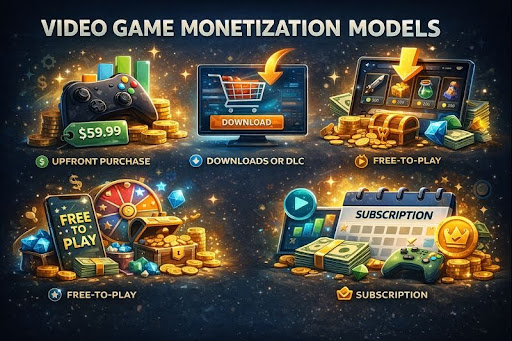
Premium (Upfront Purchase) Model
The premium model is the most traditional approach: players pay once to access the full game.
How it works
- One-time purchase price
- Revenue is concentrated around launch and early sales windows
- Minimal ongoing monetization unless expansions are added
Why publishers use it
- Clear value proposition for players
- Predictable pricing and messaging
- Lower live-service overhead
Investor considerations
- Revenue spikes early, then tapers quickly
- High reliance on launch marketing and reviews
- Limited long-term upside without DLC or re-releases
This model works best for single-player, narrative-driven, or prestige titles where completeness and quality are the primary selling points, such as story-led games or auteur-driven projects that prioritize a finished, self-contained experience at launch over live-service features or long-term content pipelines.
Downloadable Content (DLC) and Expansions
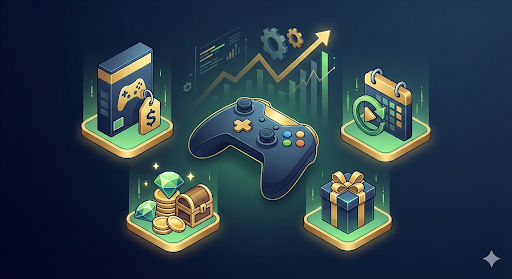
DLC extends a premium game’s lifecycle by selling additional content after launch.
Common forms
- Story expansions
- New characters or maps
- Cosmetic or gameplay add-ons
Why it matters
- Increases average revenue per user (ARPU)
- Monetizes the most engaged players
- Helps smooth revenue between releases
Business implications
- Requires ongoing development investment
- Risk of player backlash if perceived as content removed from launch
- Strong signal of franchise longevity when adoption rates are high
Consistent DLC performance often reflects a durable and engaged audience, as repeat adoption of expansions or content packs indicates sustained interest beyond the initial launch window.
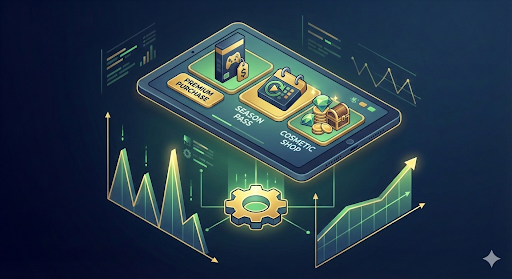
Free-to-Play (F2P) with Microtransactions
Free-to-play removes the upfront price barrier and monetizes players over time through optional purchases.
Typical monetization mechanics
- Cosmetic items
- Convenience upgrades or time-savers
- Battle passes or seasonal progression systems
Why publishers favor it
- Lower friction for player acquisition
- Long-tail revenue potential
- Strong opportunities for live optimization
Risks and realities
- A small percentage of players generate the majority of revenue
- Requires continuous content updates and live operations
- Monetization design must carefully balance fairness and profitability
From an investment standpoint, F2P titles offer outsized upside but only with disciplined acquisition costs and strong retention.
Subscription-Based Models
Subscription models charge players a recurring fee for ongoing access to games or services.
Common implementations
- Platform subscription (access to a curated or rotating game library, e.g., Game Pass–style)
- Single-title subscription (recurring fee for ongoing access to one game, common in Massively multiplayer online games {MMOs})
- Season pass / battle pass (time-limited progression or content access layered on top of premium or free-to-play models)
Why this model appeals to investors
- Predictable, recurring revenue streams
- Higher lifetime value from committed users
- Reduced dependence on single launch events
Key challenges
- Constant demand for fresh content
- Churn risk if value perception declines
- High operational expectations
Subscriptions perform best when backed by deep content pipelines and long-term player trust, such as live games or MMOs that deliver regular updates, expansions, or seasonal content to justify ongoing fees.
Hybrid Monetization Models
Most modern games rely on multiple revenue streams rather than a single approach.
Common hybrid strategies
- Premium purchase combined with DLC and cosmetics
- Free-to-play with battle passes and paid expansions
- Subscription access with optional microtransactions
Why hybrids dominate the market
- Revenue diversification reduces risk
- Different player segments can be monetized appropriately
- Increases overall lifetime value without overdependence on one model
For publishers, hybrid models offer flexibility, such as combining upfront sales with optional cosmetics or DLC. For investors, they often indicate monetization maturity and long-term planning by reducing reliance on any single revenue stream.
Advertising-Based Revenue
Advertising-driven monetization is most common in mobile and casual games.
Typical formats
- Rewarded video ads
- Banner or interstitial ads
- Sponsored in-game placements
Key considerations
- Requires large-scale player bases
- Lower revenue per user compared to other models
- Poor implementation can negatively impact retention
Advertising is generally used as a supplement rather than a primary strategy for core or mid-core games.
Reading Revenue Models as Business Signals
Revenue models reveal how a game is expected to operate long-term.
For publishers, monetization choices influence:
- Team size and specialization
- Content production cadence
- Marketing and user acquisition timing
- Community and live-operations support
For investors, revenue models help clarify risk and return profiles:
- Front-loaded models emphasize launch performance
- Recurring models signal long-term engagement strategies
- Hybrid approaches suggest optimization for lifetime value
Understanding the model provides insight into whether success hinges on a single release moment or sustained performance over time.
Monetization Shapes the Entire Business
Monetization is not a feature added at the end of development. It shapes budgets, timelines, staffing, and player expectations from the earliest stages.
The most durable games align three elements:
- A revenue model suited to the target audience
- A sustainable content and operations plan
- A clear and fair value exchange with players
For publishers and investors, evaluating monetization is ultimately about long-term viability. Increasingly, the key question is not how much a game earns at launch—but how reliably it can generate value over time.