If you can learn to “read” a studio the way investors do, you’ll spot the difference between a “cool pitch” and a company that can actually ship, scale, and survive.
Scrolling through any game studio profile reveals the same surface-level signals: a slick logo, a short “about” blurb, a couple of screenshots, and a list of games. Most audiences stop there.
An investor doesn’t. They treat the profile like a compressed business case.Not because investors are smarter, but because they’re trained to look for risks: delivery risk, market risk, team risk, monetization risk, and the biggest one: will this studio still exist long enough to finish what it’s envisioning?
This article guides you how to break a studio profile down like an investor would–using simple checks you can do in minutes, with no finance degree required.

Start with the only question that matters: What are they really building?
Studiosoften say what they are (“We’re a passionate team building immersive experiences”), but not what they do.
Investors translate the description into one clear line:
Genre + audience + platform + business model.
You want one sentence that explains how the studio plans to win.
Examples of what you’re trying to extract:
- Midcore co-op roguelite for PC/console with strong replayability and long-tail DLC.
- Mobile live-service strategy game built for long-term retention and monetization.
If you can’t rewrite the profile into something that concrete, that’s your first yellow flag. It usually means the studio hasn’t made the hard decisions yet, or is hiding them.
Look for proof of execution, not ambition
Most profiles are heavy on vision. Investors want evidence.
What counts as real proof inside a profile:
- A shipped game (even small)
- A public roadmap that matches what they’ve already demonstrated
- Gameplay footage (not just key art)
- Patch notes, devlogs, or community updates (signals shipping discipline)
- Team credits on released titles
What doesn’t count:
- “Stealth launching soon”
- “Former AAA veterans” with no shipped credits listed
- Cinematic trailers with no gameplay context
A clean rule: if a studio’s profile is mostly promises, you’re not evaluating a studio. You’re evaluating hope.
Shipping alone doesn’t guarantee success, but it’s still the baseline.
Team signals: Can this group finish the kind of game they’re promising?
Investors don’t just ask “Is the team talented?” They ask:
- Is the team complete for the scope?
- Is leadership relevant to the genre/platform?
- Have they shipped together, or only individually?
Investor-style team checklist:
- Creative and production coverage: who owns decisions, and who owns schedules?
- Technical coverage: if it’s online, who owns the backend and networking?
- Content coverage: if it’s content-heavy, who owns pipeline and tooling?
- Live ops coverage: if it’s a service, who owns retention, events, and the economy?
A studio can be stacked with talent and still be structurally underbuilt for what it’s trying to ship. Profiles that list only founders and a big dream often fall into that trap.
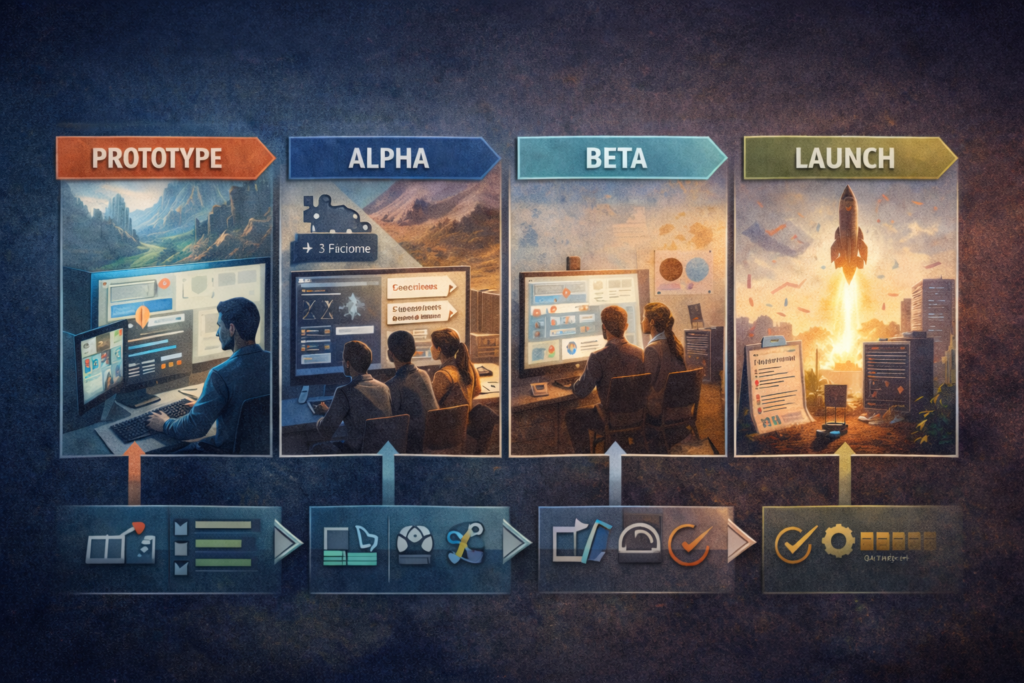
Pipeline tells: Do they understand the path from concept to launch?
Studios that have shipped before communicate differently. They don’t just say “We’re making a game.” They show the steps.
Investor pipeline signals that matter:
- Clear milestones (prototype > vertical slice > alpha > beta > launch)
- Specificity as regards scope (“single biome at launch,” “3 factions,” “10–12 hour campaign”)
- Realistic production choices (reusable systems, modular content, limited platforms early)
Studios that are vague here often aren’t being mysterious. They’re being uncertain.
Business model: How do they plan to earn, and for how long?
Even if a profile doesn’t explicitly mention monetization, you can usually infer it from:
- Platform (mobile vs PC vs console)
- Game structure (run-based vs narrative vs competitive)
- Content cadence (one-and-done vs ongoing)
Investor questions to ask while reading:
- Is this a one-time purchase game, or designed for ongoing spend?
- If it’s premium, what’s the replayability hook?
- If it’s live service, what’s the retention loop?
- If it’s multiplayer, how are they handling servers and longevity?
If the profile positions the studio as “live service” but shows no community infrastructure, no cadence, and no evidence of operations, it’s a mismatch.
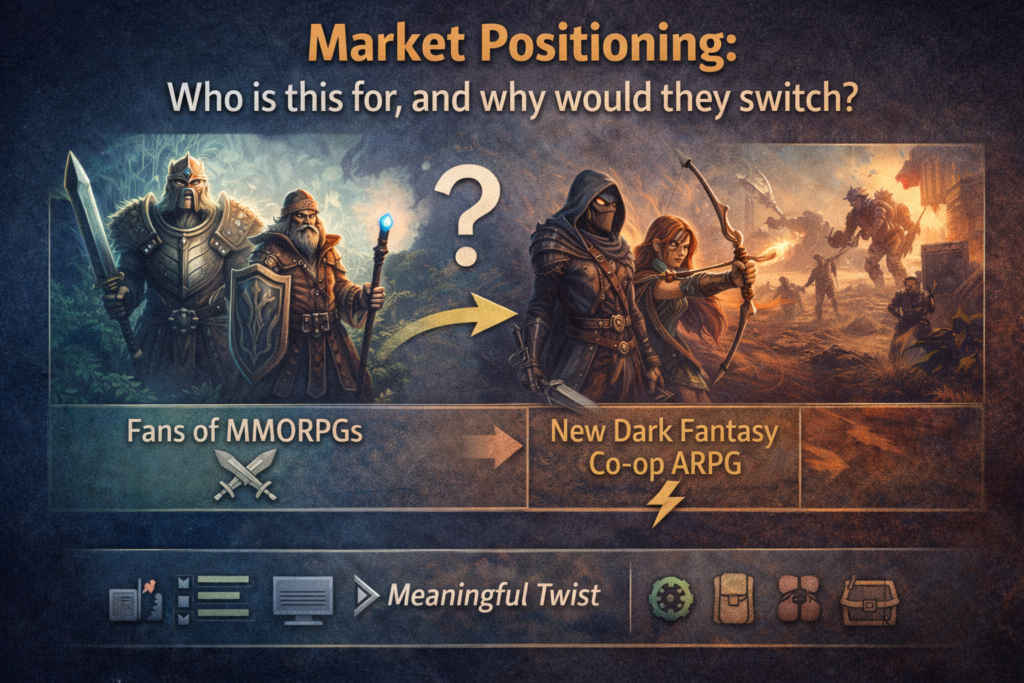
Market positioning: Who is this for, and why would they switch?
Investors look for differentiation that’s easy to explain.
You’re looking for:
- A clear target player type (not “everyone”)
- A clear comparable (“fans of X and Y”)
- One meaningful twist (mechanic, fantasy, etc.
- A reason players would leave a similar existing game to try this one
If the profile feels like it’s trying to impress developers more than players, that’s another quiet risk signal.
Traction: Are players already voting “yes”?
A studio profile might not show full metrics, but it often shows proxies:
- Community size and activity (Discord, social engagement)
- Wishlist calls-to-action (PC)
- Playtest access or demo availability
- Frequent updates and feedback loops
Investors know traction reduces risk. A small but real community is worth more than a big promise.
Funding and partnerships: Useful if it’s specific, suspicious if it’s vague
If a studio claims partnerships, look for specificity:
- Named publisher or platform partner
- Named accelerator or fund
- Clear outcome (funding round, signed publishing deal, platform feature)
Vague phrasing like “in talks with partners” or “backed by industry leaders” without names is usually marketing filler.
Red flags you can spot in 30 seconds
- Big scope + tiny team + no shipped work shown
- Cinematic-first presentation with no gameplay
- Buzzwords instead of specifics (“immersive,” “innovative,” “redefining”)
- Live service language with no community or cadence
- No clear platform strategy
- No clear plan for what happens after launch
None of these guarantee failure, but each one increases risk the same way an investor would score it.
| Red Flags You Can Spot in 30 Seconds | Quick risk signals in studio profiles | |||
| Area | What you see | Risk signal | Signal |
| Scope vs Team | Big vision + tiny team + no shipped work | Execution risk | ○ |
| Presentation | Cinematic trailer but no real gameplay | Product risk | ○ |
| Language | Buzzwords (‘immersive,’ ‘redefining,’ ‘innovative’) | Marketing fluff | ○ |
| Live Service Claims | Mentions live ops but no community or cadence | Sustainability risk | ○ |
| Platform Strategy | No clear target platform (PC, console, mobile) | Distribution risk | ○ |
| Post-Launch Plan | No roadmap beyond release | Retention risk | ○ |
Quick Risk Score Guide
0–2 red flags > Low visible risk
3–4 red flags > Moderate risk
5+ red flags > High execution risk
The investor lens is just a clarity lens
The best studio profiles don’t feel like sales pages. They feel like evidence: “here’s what we’re making”, “here’s what we’ve shipped”, “here’s how we’re building it”, and “here’s why players will care”.
If you can consistently extract those answers, you’ll read any studio profile faster, smarter, and with fewer surprises, whether you’re investing money or time.