How successful publishers think beyond launch and build products that last.
Why the Lifecycle Matters More Than Ever
For publishers and investors, a video game is no longer a product with a single sales spike. It is a multi-year asset whose value is shaped long before launch and often determined well after it.
Rising development costs, longer production timelines, and crowded storefronts have changed the economics of games. The question is no longer “Will this game launch well?” but “Can this game sustain revenue, relevance, and brand value over time?”
Understanding the full game lifecycle, from early concept to long-term sales is essential for evaluating risk, allocating capital, and building portfolios that endure.
Concept & Market Fit: Where ROI Is Quietly Decided
The lifecycle begins well before a pitch deck reaches greenlight.
At the concept stage, strong teams are not just asking what the game is, but who it is for and why it should exist in the current market. Genre saturation, player expectations, and monetization norms all influence whether a concept has commercial headroom.
From a publisher’s perspective, key questions include:
- Is there a clearly defined target audience with proven spending behavior?
- Does the concept align with a scalable business model (premium, live service, hybrid)?
- Can the IP extend beyond a single release?
Projects that fail commercially often do not suffer from poor execution, they suffer from weak positioning that no amount of polish can fix later.
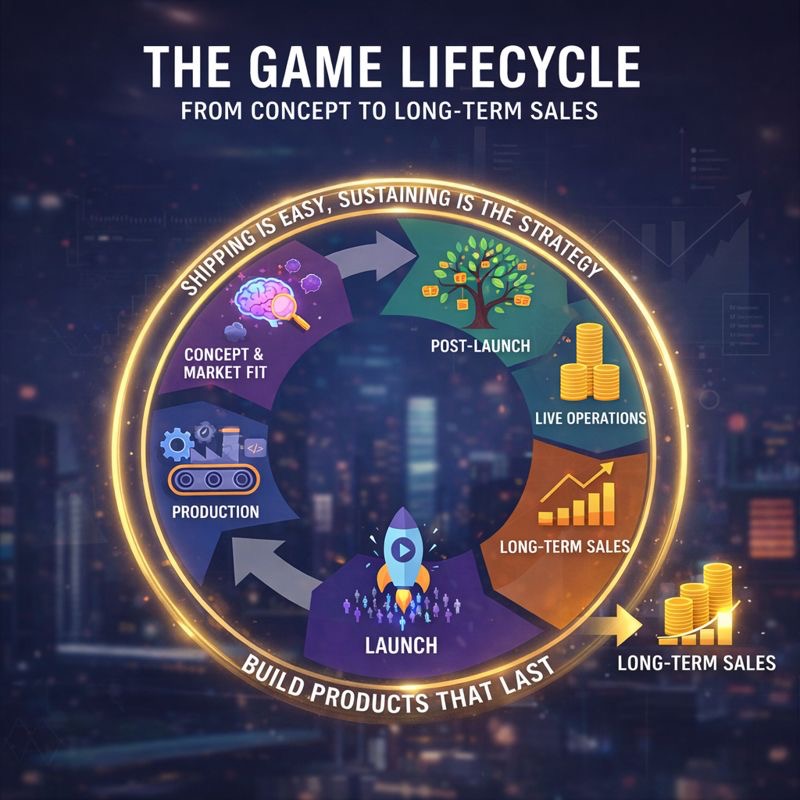
Production: Managing Burn, Scope, and Optionality
Once in production, the lifecycle becomes a financial balancing act.
For investors, this phase represents the highest burn rate and the least external validation. Milestone-based funding, vertical slices, and playable builds are not just development tools, they are risk-management mechanisms.
Successful publishers look for:
- Clear scope control and disciplined feature prioritization
- Technology choices that reduce long-term maintenance costs
- Design systems that allow for post-launch expansion
Launch: A Moment, Not the Goal
Launch used to be the finish line. Today, it is a stress test.
Marketing spend, platform featuring, and influencer campaigns can drive strong Day 1 sales, but launch performance alone rarely defines lifetime value. What matters more is conversion into a retained audience.
From a publisher’s angle, launch metrics to watch include:
- Retention beyond the first 7–30 days
- Monetization behavior of early cohorts
- Community sentiment and content velocity
A “soft” launch with strong retention can outperform a flashy launch with steep drop-off. Increasingly, capital follows engagement curves, not launch headlines.
Post-Launch: Where Games Become Businesses
Post-launch is where the lifecycle truly differentiates winners from write-offs.
Live updates, DLC, seasonal content, and events extend both revenue and relevance. Even premium titles now rely on post-launch strategies to maximize long-tail sales.
For publishers and investors, this phase answers critical questions:
- Can the team operate the game efficiently over time?
- Does new content materially re-engage lapsed players?
- Are acquisition costs declining as word-of-mouth grows?
Games that sustain healthy post-launch ecosystems often transition from single products into ongoing platforms, lowering risk for sequels, spin-offs, and transmedia opportunities.
Long-Term Sales: When a Game Turns Into an Asset
The final stage of the lifecycle is not decline, it is consolidation.
Back-catalog sales, subscriptions, bundles, and regional expansions continue generating revenue long after launch. For large publishers and holding companies, this long tail can represent a significant portion of annual income.
From an investment standpoint, mature titles offer:
- Predictable cash flow
- Lower marketing spend per unit sold
- Strategic leverage in platform negotiations and acquisitions
Games with long sales tails also increase studio valuation, as they have commercial reliability and operational maturity.

The Publisher’s Advantage: Designing for Endurance
What separates resilient publishers from reactive ones is intent.
Games built with lifecycle thinking bake longevity into their structure: modular content, extensible systems, and communities designed to persist. These choices are invisible at launch but decisive over time.
For investors, lifecycle awareness reframes evaluation. Instead of asking whether a game will peak, the better question is whether it will compound.
The most valuable titles are not those that burn brightest at release, but those that continue to justify attention, investment, and iteration years later.

Shipping Is easy but sustaining is the strategy
In today’s market, releasing a game is table stakes. Sustaining one is a competitive advantage.
For publishers and investors, the real opportunity lies in backing teams and concepts that are built not just to ship—but to endure.
Games built with long-term product strategy reduce financial volatility. They create room to test assumptions, respond to player behavior, and extend revenue through post-launch content, pricing strategies, catalog sales, and IP expansion. This approach shifts games from high-risk, single-event products into assets that can compound value across multiple years.
Looking ahead, the industry will increasingly reward teams that demonstrate long-term intent early. Clear audience definition, production pipelines built for ongoing support, launch strategies focused on retention, and credible post-launch operating plans will matter more than short-term hype.
As costs rise and competition tightens, lifecycle discipline will become a key indicator of sustainable growth—and a critical lens through which publishers and investors evaluate future opportunities.