Crom’s Escape review: gameplay, mechanics, and indie development insights from Amphoteric Studio’s debut mobile game.
Introduction
A few days ago, we downloaded and played Crom’s Escape, the debut release from Amphoteric Game Studio, and we also had the chance to speak with its creators. In this feature, we explore the inspiration behind the game along with the key challenges and opportunities facing indie game developers today.
A Sneak Peek Inside Amphoteric Studio
“Small team. Clear ideas. Playable experiments.”
That’s how Amphoteric Game Studio introduces itself on its official website—a small, unconventional creative team made up of four people working fully remotely.
Founded in October 2025 and based in London, the studio operates across borders, with team members located between Venezuela and Europe.
The team itself is refreshingly non-traditional: a human resources specialist, a physicist, a chemist, and a creative education professional who is also a pixel art pro—professionals with different backgrounds, languages, and career paths. Within the studio, they take on roles as game developers, designers, and creatives.
What brings them together is a shared passion for gaming and a drive to experiment and build unique player experiences.
In addition to developing their own original games, Amphoteric Studio also offers services to external clients—ranging from creating games, software, and apps on demand.
The Challenges Facing Indie Game Developers
In our conversations with the team, two major challenges stood out, both highly relevant across today’s indie game landscape.
Visibility and community building
One of the biggest hurdles for small studios is getting noticed. Without big marketing budgets or publishing support, attracting players and building a loyal community becomes a real challenge.
This raises a key question: how can indie developers build strong, engaged communities in a market flooded with content?
Budget and funding limitations
Closely tied to visibility is the issue of funding. Many indie developers rely on personal income to sustain their projects, which can limit both growth and creative scope.
Even when the technical skills are there, the need to monetize and secure external investment often becomes a major barrier to expanding game worlds and sustaining long-term development.
Strengths and Opportunities of Indie Studios
Despite these challenges, small indie teams like Amphoteric Studio also have clear strengths.
First, there’s the ability to do a lot with a little. Small teams can still cover the technical and creative ground needed to build compelling game worlds. Amphoteric proves this with Crom’s Escape, a visually engaging and dynamic experience and with Velo Cromato, a fascinating experimental project we’ll explore later.
Second, adaptability. Small teams tend to be more flexible and versatile. With overlapping skill sets, ranging from programming and design to communication and multilingual collaboration, they can move quickly and creatively.
This combination makes Amphoteric Studio a compact but powerful engine for game and app development.
Crom’s Escape: A Bouncy, Addictive Mobile Game
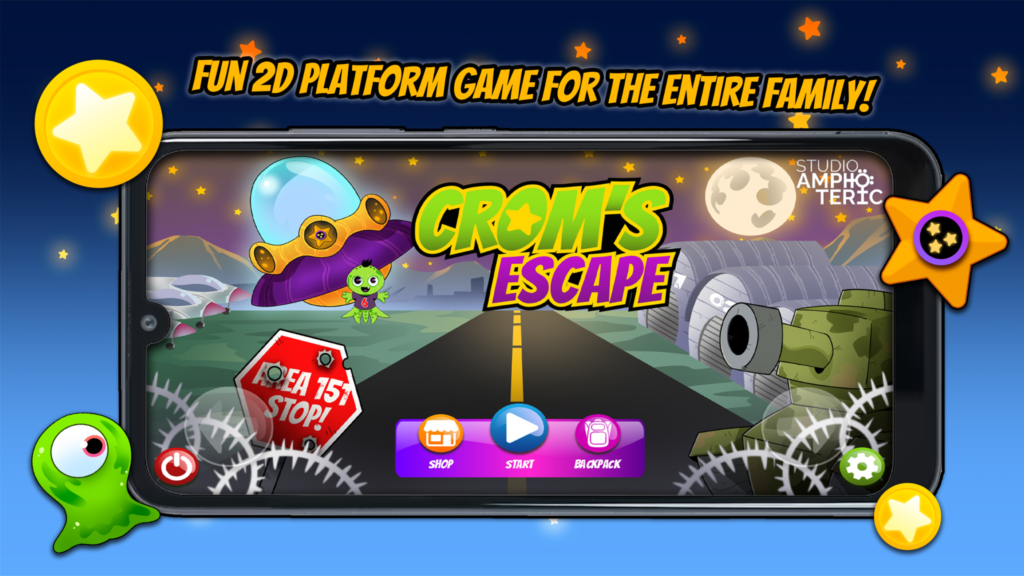
At its core, Crom’s Escape follows a simple setup: a friendly alien crash-lands on Earth and must work his way through a series of maze-like levels to rebuild his ship and get home.
On screen, Crom is never still. He constantly hops in place, giving the game a restless, kinetic feel from the first level. Every move you make is about timing—guiding his bounces through narrow corridors, around corners, and past hazards that punish even small mistakes.
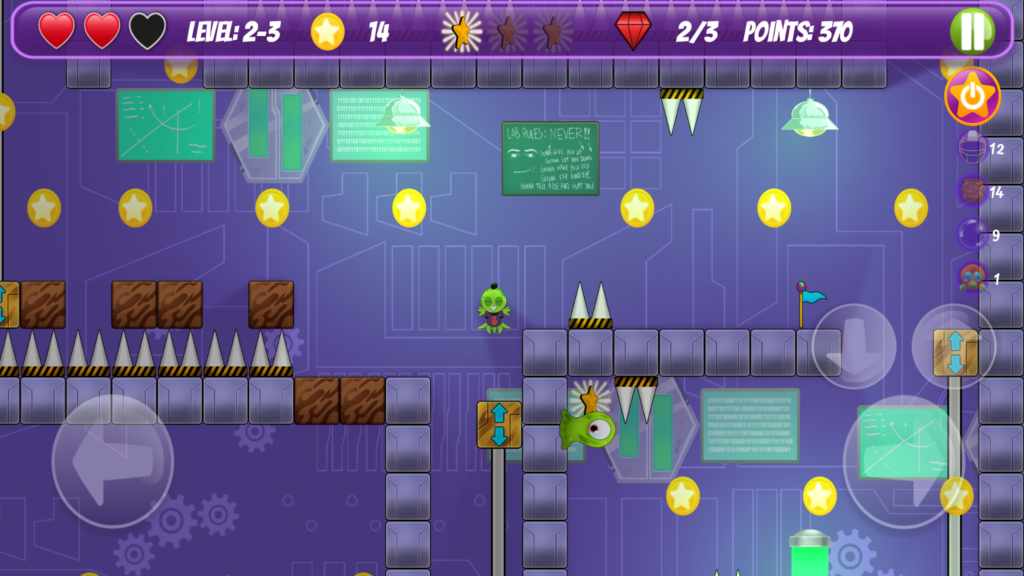
Each maze feels compact but busy. Enemies patrol tight spaces, forcing quick decisions as Crom ricochets between walls. One mistimed jump can send him straight into danger, costing a life and resetting your rhythm. The challenge builds naturally: early levels ease you in, but later stages demand sharper reflexes and better planning.
Power-ups add short bursts of control in an otherwise unpredictable system. A helmet lets Crom absorb a hit, gloves improve maneuverability, and protective bubbles give brief moments of safety as you push through tougher sections. These tools don’t slow the game down—they give you just enough breathing room to keep going.
Visually, the game blends clean 2D design with distinct themes. Some levels resemble bright, lab-inspired spaces filled with chemical motifs and sharp edges, while others lean into darker, dungeon-like layouts with tighter paths and more pressure. The contrast keeps each stage feeling fresh without overcomplicating the design.
Released on March 23, 2026, Crom’s Escape stands out for one defining idea: you’re never in full control. Crom’s constant jumping turns even simple navigation into a test of timing and precision. The result is a fast, repeatable gameplay loop that’s easy to pick up, challenging to master, and built for quick sessions that often turn into longer runs.
Copyright 2026 © Amphoteric Game Studio https://amphotericstudio.com/
Community Feedback and Game Updates
Since launch, community feedback has played a crucial role in refining the game.
Interestingly, much of this feedback comes from fellow developers, whose insights have helped improve gameplay and the overall user experience from a more technical perspective.
Looking ahead, the next step for Crom’s Escape is expanding beyond mobile, bringing the game to PC platforms.
Copyright 2026 © Amphoteric Game Studio https://amphotericstudio.com/
What’s Next for Amphoteric Studio?
While Crom’s Escape is their flagship title, Amphoteric Studio is already working on new projects alongside client work.
Velo Cromato
One of their most intriguing upcoming titles is Velo Cromato. Originally developed during a 48-hour game jam in Zulia, Venezuela, the game already has a playable version with three levels, but the team plans to expand it further.
This innovative 2D experience revolves around color and mechanics. Players control Tenebria, navigating lifeless, colorless environments where progression depends on using different masks, each offering a unique way to interact with the world.
These abilities allow players to reveal, materialize, or activate platforms, turning movement into a puzzle-solving experience. Progression isn’t just about overcoming obstacles, it’s about restoring color, and with it, meaning, to the world itself.
LoryForg
Their second project, LoryForg, is still in development.
As described on the studio’s website, it’s a strategy card game that “combines turn-based gameplay with card mechanics on a hexagonal battlefield, where two players attempt to surround or destroy the enemy fortress.”
Its cards, factions, and tactical systems are part of a broader, expandable universe, hinting at long-term ambitions beyond a single title.
Takeaway
All things considered, Amphoteric Studio is definitely one to watch.
With a strong experimental mindset, a diverse team, and a growing portfolio, they represent exactly the kind of creative energy driving today’s indie game scene forward.